
Ceramic balls
Ceramic balls made of Si₃N₄, Al₂O₃ and ZrO₂ for rolling bearings, pumps, valves and dosing technology – properties and operating limits compared.
Precision balls made of technical ceramics
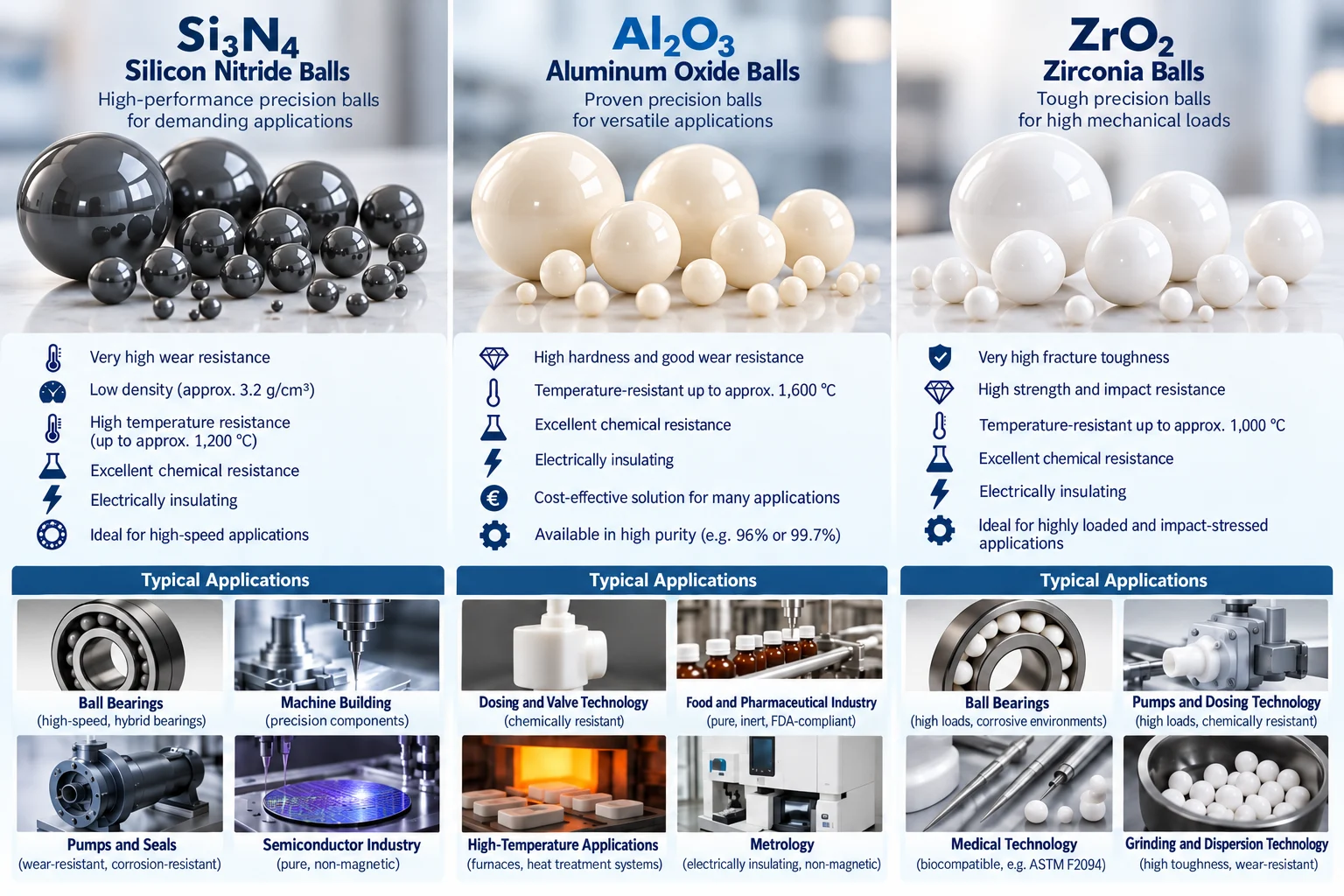
Most of the ceramic balls we supply are made of silicon nitride: light, hard and built for high speeds. Alongside it stand alumina as the proven, economical solution and zirconia for high mechanical loads.
Si₃N₄ balls made of silicon nitride
Silicon nitride balls (Si₃N₄, often written Si3N4) are the first choice for fast-running rolling bearings. At 3.2–3.3 g/cm³ they are considerably lighter than steel balls, very wear-resistant and electrically insulating. In hybrid bearings they run in steel rings and are built for high speeds. Further fields are mechanical engineering, pumps and seals, and the semiconductor industry, where clean, non-magnetic components matter.
Al₂O₃ balls made of alumina
Alumina balls (Al₂O₃, also Al2O3) are the economical solution for many applications: hard, chemically very resistant and usable in air up to approx. 1,400–1,700 °C. For food and pharma they are FDA-compliant. Typical uses are dosing and valve technology, the food and pharmaceutical industry, high-temperature applications such as furnaces and heat-treatment plants, and measurement technology. Because of their lower fracture toughness they are less suited to shock loads.
ZrO₂ balls made of zirconia
Zirconia balls (ZrO₂, also ZrO2) are the toughest of the three. High strength and impact toughness make them the choice for highly loaded and shock-loaded applications. They are used in rolling bearings for high loads and corrosive environments, in pumps and dosing technology, in medical technology, and as grinding balls in grinding and dispersing technology. Where hot water or steam is involved, yttria-stabilised ZrO₂ (Y-TZP) should be checked for hydrothermal ageing.
Three materials
High-performance balls for demanding applications: very wear-resistant, low density, ideal for high speeds.
Proven and versatile: high hardness, very good chemical resistance, cost-efficient, FDA-compliant. Available in high purity, e.g. 96 % or 99.7 %.
Tough and impact-resistant: for highly loaded and shock-loaded applications.
Si₃N₄, Al₂O₃ and ZrO₂ compared
| Property | Si₃N₄ (silicon nitride) | Al₂O₃ (alumina) | ZrO₂ (yttria-stabilised) |
|---|---|---|---|
| Density | 3.2–3.3 g/cm³ | 3.6–3.9 g/cm³ | 6.0–6.1 g/cm³ |
| Hardness (Vickers) | 15–16 GPa | 12–18 GPa | 12–16 GPa |
| Fracture toughness | 6–8 MPa√m | 4–5 MPa√m | 7–13 MPa√m |
| Wear resistance | very good to excellent | good to very good | good to very good |
| Resistance to impact loads | good | rather low | very good |
| Risk of chipping under impact | lower | comparatively higher | lower |
| Thermal conductivity at room temperature | approx. 15–35 W/(m·K) | approx. 20–35 W/(m·K) | approx. 2–3 W/(m·K) |
| Thermal insulation | low to medium | low to medium | high |
| Maximum service temperature in air | approx. 1,000–1,400 °C | approx. 1,400–1,700 °C | approx. 800–1,000 °C (Y-TZP) |
| Thermal shock resistance | very good | medium | rather limited |
| Resistance to acids | very good against many acids; depends on grade and microstructure | very good against many acids; sensitive to hydrofluoric acid (HF) | very good against many acids; HF can attack |
| Resistance to alkalis | good to very good, depending on temperature and composition | good, but hot or concentrated alkalis can attack | good to very good, depending on medium and temperature |
| Resistance to water / steam | good under many conditions; hydrothermal attack on grain-boundary phases possible | good under usual conditions; limited hydrothermally at high temperatures | good under usual conditions; Y-TZP can age under prolonged hot water or steam exposure |
| Typical advantages | combination of hardness, toughness and thermal shock resistance | high hardness, temperature resistance and economy | high fracture toughness, impact resistance and low thermal conductivity |
Chemical resistance is a general qualitative classification. It depends strongly on concentration, temperature, exposure time and the specific ceramic grade; all three materials react differently to particular acids and alkalis.
In short
Al₂O₃ is a versatile, economical material with good chemical resistance. Si₃N₄ often offers the best combination of wear resistance, toughness and thermal shock resistance. Yttria-stabilised ZrO₂ is particularly interesting for high mechanical loads, but should be checked for hydrothermal ageing where hot water or steam is involved.
Sizes and grades
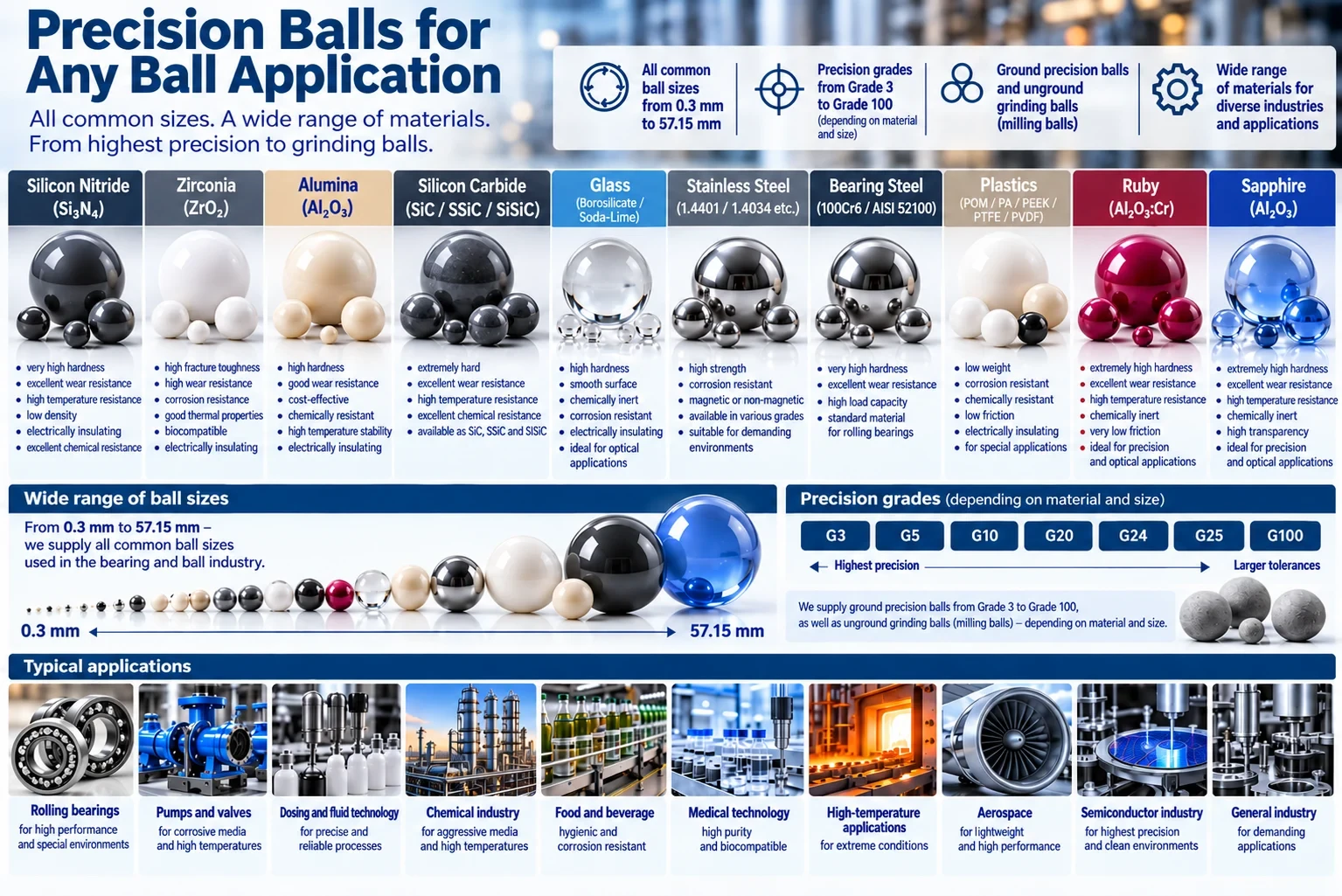
We supply balls from 0.3 mm to 57.15 mm in diameter, covering all common sizes used in the rolling and ball bearing industry. Ground precision balls are available in grades G3, G5, G10, G20, G24, G25 and G100, as well as unground grinding balls. Which size and grade is available depends on the material.
Further ball materials
| Material | Properties |
|---|---|
| Silicon carbide (SiC, SSiC, SiSiC) | extremely hard, excellent wear resistance, high temperature resistance, very good chemical resistance |
| Glass (borosilicate, soda-lime) | high hardness, very smooth surface, chemically inert, electrically insulating, for optical applications |
| Stainless steel (e.g. 1.4401, 1.4404, 1.4125, 1.4034) | high strength, corrosion-resistant, magnetic or non-magnetic, in various grades; 1.4401 and 1.4404 are acid-resistant |
| Bearing steel (100Cr6 / AISI 52100) | very high hardness, high load capacity, the standard material for rolling bearings, available from G3 to G100 |
| Plastics (POM, PA, PEEK, PTFE and others) | low weight, corrosion- and chemical-resistant, low friction, electrically insulating |
| Ruby (Al₂O₃:Cr) | extremely hard, very wear-resistant, chemically inert, very low friction, for precision and optical applications |
| Sapphire (Al₂O₃) | extremely hard, very wear-resistant, chemically inert, high transparency, for precision and optical applications |
Si₃N₄ balls: main properties
- Very high wear resistance
- Low density (3.2–3.3 g/cm³)
- Very good thermal shock resistance, in air up to approx. 1,000–1,400 °C
- Very good chemical resistance against many acids
- Electrically insulating
- Ideal for high-speed applications
Typical applications
- Rolling bearings & hybrid bearings
- Mechanical engineering
- Pumps & seals
- Semiconductor industry
- Dosing & valve technology
- Food & pharmaceutical industry
- High-temperature applications
- Measurement technology
- Medical technology
- Grinding & dispersing technology
Frequently asked questions about ceramic balls
Si3N4 or ZrO2: which ceramic ball suits which bearing?
Si₃N₄ is the choice for high speeds: low density and very high wear resistance. ZrO₂ shows its strength under high loads, shocks and in corrosive environments, because it has the highest fracture toughness of the three materials.
When are Al2O3 balls sufficient?
When hardness, chemical resistance and temperature count but no shock loads occur. Al₂O₃ can be used in air up to approx. 1,400–1,700 °C, is FDA-compliant and the cost-efficient solution, for example in dosing and valve technology.
Are ceramic balls electrically insulating?
Yes, all three materials insulate electrically. That is an advantage wherever no current should pass through the bearing.
Which sizes and grades does MG supply?
Diameters from 0.3 mm to 57.15 mm, ground in grades G3 to G100 or unground as grinding balls, each depending on material and size.
What does MG need for a quotation?
Material, diameter, quantity and the operating conditions such as temperature, medium and speed. If the material is still open, we recommend one based on your application.
Request balls
In the guided request you tell us material, dimensions and operating conditions in four steps.
Learn more
Why Al₂O₃ balls suit pumps is covered in the article Al₂O₃ ceramic balls. Ceramic balls in the bearing: hybrid & all-ceramic rolling bearings.
Spellings: Si₃N₄ also Si3N4, Al₂O₃ also Al2O3, ZrO₂ also ZrO2.
Reduce failures, maintenance and downtime.
Let us check together whether ceramic or hybrid solutions can lower your operating costs — with individual advice instead of a datasheet overload.