
SSiC vs. SiSiC
Sintered and silicon-infiltrated silicon carbide compared: where the difference lies, why free silicon sets the operating limit and when each material fits.
About the figures
The figures in the first table are typical literature values for orientation; the second table classifies operating limits and chemical resistance. For your specific design we agree the figures of the material actually used with you.
Material comparison · Silicon carbide
Silicon carbide is not simply silicon carbide. Between SSiC and SiSiC lies a difference that decides the operating limit in practice: the free silicon.
The difference in one sentence
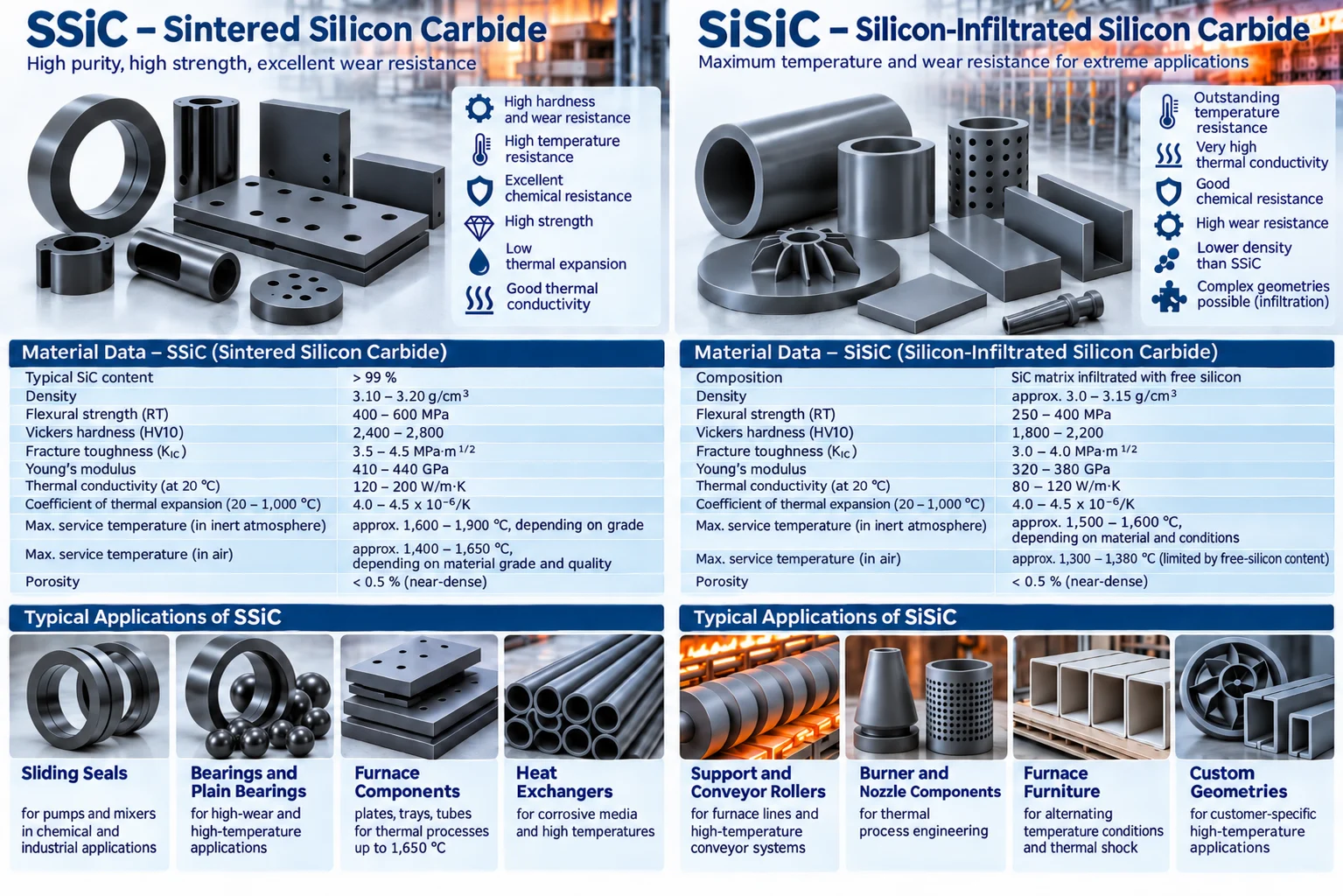
SSiC (sintered silicon carbide) consists almost entirely of SiC. SiSiC (silicon-infiltrated silicon carbide) is a SiC skeleton whose open pores are filled with elemental silicon — typically 80–90 % SiC and 10–20 % free Si.
Properties compared
| Property | SSiC | SiSiC |
|---|---|---|
| Main constituent | almost entirely SiC | SiC + approx. 10–20 % free Si |
| Density | approx. 3.1–3.2 g/cm³ | approx. 3.0–3.2 g/cm³ |
| Hardness | very high, approx. 22–25 GPa | high, slightly lower |
| Flexural strength | approx. 300–600 MPa | approx. 200–400 MPa |
| Young's modulus | approx. 400–450 GPa | approx. 350–420 GPa |
| Thermal conductivity | approx. 80–200 W/m·K | approx. 120–200 W/m·K |
| Thermal expansion | approx. 4.0–4.5 ×10⁻⁶/K | approx. 4.0–4.5 ×10⁻⁶/K |
| Oxidation resistance | very good | good, depending on temperature and atmosphere |
| Use above approx. 1,400 °C | clearly in favour | limited by free silicon |
| Complex geometries | harder and more expensive | very well suited |
| Large parts | harder | comparatively good |
| Cost | usually higher | usually lower |
Typical material properties as orientation for choosing a material. These are not guaranteed engineering data; what counts are the figures for the specific component.
Why the free silicon matters
Free silicon melts at about 1,414 °C. Up to around 1,000 °C both materials are well suited. In air, SiSiC typically remains usable up to about 1,300–1,380 °C, with atmosphere and load gaining weight. Above that, SSiC is the clear choice: with no free silicon that could melt or react, it typically reaches about 1,400–1,650 °C in air.
Operating limits and chemical resistance
| Property | SSiC (sintered silicon carbide) | SiSiC (silicon-infiltrated silicon carbide) |
|---|---|---|
| Manufacturing process | solid-state sintering | infiltration with liquid silicon |
| Composition | predominantly SiC, practically no free silicon | SiC with additional free silicon |
| Max. service temperature in air | typically approx. 1,400–1,650 °C | typically approx. 1,300–1,380 °C |
| Temperature resistance | very high | high, limited by free silicon |
| Acid resistance | very good against many acids | very good against many acids; depends on acid and concentration |
| Alkali resistance | limited with strong alkalis, especially at elevated temperature | also limited; free silicon can additionally be attacked |
| Resistance to oxidising agents | good under suitable conditions; strong oxidising agents can attack the surface | depends on oxidising agent, temperature and free silicon |
| Resistance to hydrogen fluoride (HF) | limited; HF can attack silicon-containing surfaces | limited; free silicon and SiC can be attacked |
| Resistance to molten metals | very good against many metals, but depends on the medium | more critical with metals that react with free silicon |
| Oxidation resistance in air | very good through formation of a protective SiO₂ layer | good, but depends on temperature and free silicon |
| Typical applications | high-temperature components, seals, chemically stressed components | kiln rollers, kiln furniture, complex structural parts |
Technical assessment
SSiC is usually the better choice when high temperatures and aggressive chemical media occur together. SiSiC offers advantages for complex geometries and for applications in which dimensional accuracy and thermal conductivity matter. With strong alkalis, hydrofluoric acid, molten metals and certain salt melts, resistance must always be checked for the specific medium and operating temperature.
Important when choosing a material
Chemical resistance depends not only on the material designation but also on purity, porosity, free silicon content, surface condition, temperature and concentration of the medium. For a reliable choice, please tell us the specific chemical with its concentration and operating temperature.
Which material fits?
Maximum service life in direct contact with hot material or an aggressive atmosphere?
Rather SSiC — without free silicon there is no additional point of reaction.
Complex geometry, larger dimensions or a tight budget?
Rather SiSiC — it is easier to shape and usually cheaper.
Rotating parts such as support rollers in continuous operation?
Here the maximum temperature alone does not decide. Radial load, speed, dimensions, temperature gradient and above all the bearing arrangement belong in the design — talk to us.
Reduce failures, maintenance and downtime.
Let us check together whether ceramic or hybrid solutions can lower your operating costs — with individual advice instead of a datasheet overload.